Disable Low-Usage PoE Ports to Cut Silent Waste
Desactiva Puertos PoE de Bajo Uso para Eliminar Desperdicio
Would you know which PoE ports are quietly wasting power?
¿Sabrías cuáles de tus puertos PoE están malgastando energía silenciosamente?
The idea
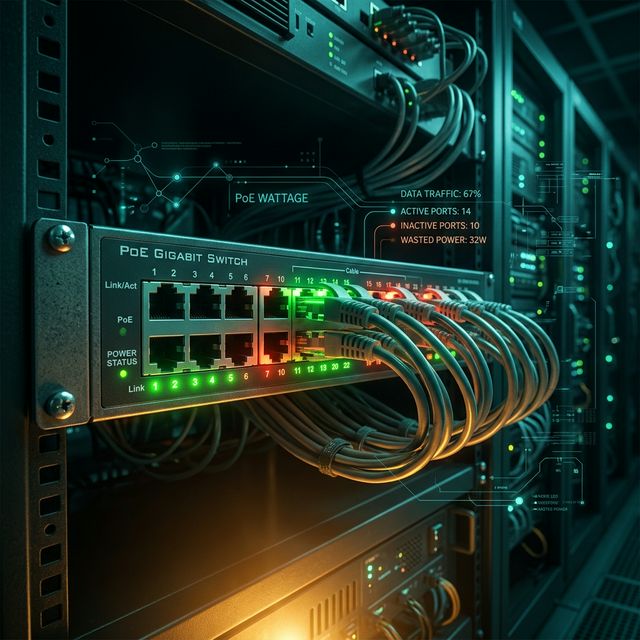
Power over Ethernet (PoE) is incredibly useful — it simplifies cabling and enables remote powering of devices like phones, badge readers, cameras, and access points. But it comes with an often-overlooked side effect: PoE ports draw power even when their connected devices are barely used or idle.
40%
of PoE ports deliver power to barely-used devices
Common finding in enterprise PoE audits
Why it matters
Every active PoE port consumes 15-30W depending on the power class. When multiplied by hundreds of ports across a campus, the waste is significant.
- 📱 IP phones in empty desks — drawing 7-15W each doing nothing
- 📸 Cameras pointing at static areas — 12-25W with negligible motion detection
- 📶 APs in low-density zones — fully powered for minimal client count
- 🚪 Badge readers in rarely-used entrances — powered 24/7 for occasional use
How to apply it
- ✅ Audit PoE port utilization — identify ports where device activity is below threshold
- ✅ Classify by criticality — security cameras ≠ conference room phones
- ✅ Disable non-critical ports — schedule them off outside business hours
- ✅ Set power budget alerts — know when a switch exceeds its expected PoE draw
💡 Example: A law firm discovered 35% of their PoE ports were feeding IP phones on desks that had been vacant for months after a hybrid work transition. Disabling them saved significant annual energy costs.
The ZeroNet approach
ZeroNet analyzes PoE consumption per port, identifies low-usage patterns, and recommends which ports can safely be disabled or scheduled — preserving service while cutting waste.
Want to see this in action?
ZeroNet detects these opportunities automatically, no sensors, no agents. Learn more.
La idea
Power over Ethernet (PoE) es increíblemente útil — simplifica el cableado y permite alimentar remotamente dispositivos como teléfonos IP, lectores de tarjetas, cámaras y puntos de acceso. Pero tiene un efecto secundario que a menudo se pasa por alto: los puertos PoE consumen energía incluso cuando los dispositivos conectados apenas se usan o están inactivos.
40%
de los puertos PoE alimentan dispositivos apenas utilizados
Hallazgo habitual en auditorías PoE empresariales
Por qué importa
Cada puerto PoE activo consume 15-30W según la clase de potencia. Multiplicado por cientos de puertos en un campus, el desperdicio es considerable.
- 📱 Teléfonos IP en escritorios vacíos — consumiendo 7-15W cada uno sin hacer nada
- 📸 Cámaras apuntando a zonas estáticas — 12-25W con detección de movimiento negligible
- 📶 APs en zonas de baja densidad — a plena potencia para un mínimo de clientes
- 🚪 Lectores de tarjetas en entradas poco usadas — alimentados 24/7 para uso ocasional
Cómo aplicarlo
- ✅ Audita la utilización de puertos PoE — identifica puertos con actividad por debajo del umbral
- ✅ Clasifica por criticidad — cámaras de seguridad ≠ teléfonos de sala de reuniones
- ✅ Desactiva puertos no críticos — prográmalos para apagarse fuera de horario laboral
- ✅ Configura alertas de presupuesto PoE — detecta cuándo un switch supera su consumo esperado
💡 Ejemplo: Un despacho de abogados descubrió que el 35% de sus puertos PoE alimentaban teléfonos IP en escritorios vacíos tras la transición al trabajo híbrido. Desactivarlos supuso un ahorro energético anual significativo.
El enfoque ZeroNet
ZeroNet analiza el consumo PoE por puerto, identifica patrones de bajo uso y recomienda qué puertos pueden desactivarse o programarse de forma segura — manteniendo el servicio mientras se reduce el desperdicio.
¿Quieres verlo en acción?
ZeroNet detecta estas oportunidades automáticamente, sin sensores, sin agentes. Saber más.